No Room for a Range? Creative Solutions for Space-Constrained Golf Courses
The Hard Mat Disappointment
I was playing a stunning desert course last week—pristine conditions, dramatic elevation changes, thoughtful routing that showcased the natural landscape. The greens were rolling pure, fairways were immaculate, and the layout was one of the most exciting I’d played all year.
Then I arrived 45 minutes early to warm up.
Two beautiful putting greens? Check. A well-maintained chipping area? Check. A driving range? Not quite. What I found instead were a dozen rock-hard rubber mats facing a net barely 30 yards away. Not 30 yards of landing area—30 yards total, with a net.
The cognitive dissonance was jarring. Here’s a course charging $225 per round with conditions that rival destinations charging double, yet they’re asking golfers to warm up by hitting balls into a net.
I watched four groups ahead of me skip the “range” entirely, opting instead to show up, putt for five minutes, and go straight to the first tee cold. Meanwhile, I hit exactly seven balls before my hands hurt from the mat impact, learned nothing about my swing that day, and headed to the first tee feeling unprepared.
This course isn’t alone. Across the country, hundreds of excellent golf courses face the same challenge: limited real estate makes a traditional driving range impossible. But here’s the critical question: Does “no room for a range” mean you’re stuck with hard mats and a net?
Absolutely not.
Let’s explore creative, practical, and revenue-generating solutions that turn your practice facility limitation into a competitive advantage.
Why the Traditional Range Isn’t Always Possible
The Real Estate Reality
A quality driving range requires:
- Minimum 250-300 yards of depth (ideally 350+ yards)
- 150-200 yards of width for safe dispersion
- Relatively flat or consistent slope for ball retrieval
- 10-15 acres of usable land total
- Separation from play corridors for safety
- Practical ball retrieval logistics
For urban courses, resort properties with limited footprints, courses carved into mountainous terrain, or facilities built on expensive real estate, dedicating 10-15 acres to a range simply isn’t feasible—or financially justifiable.
The Financial Calculation
Even when space exists, the economics can be challenging:
Range Construction Costs:
- Land clearing and grading: $100,000-250,000
- Irrigation installation: $150,000-300,000
- Turf establishment: $75,000-150,000
- Netting/containment: $50,000-200,000
- Lighting (if applicable): $75,000-150,000
- Mat area construction: $40,000-80,000
- Ball dispensing system: $30,000-60,000
- Total: $520,000-1,190,000+
Annual Operating Costs:
- Maintenance labor: $40,000-80,000
- Irrigation/water: $15,000-35,000
- Equipment/repairs: $10,000-25,000
- Range ball replacement: $8,000-20,000
- Total: $73,000-160,000/year
For many courses, this investment doesn’t pencil out—especially when the space could be used for real estate development, additional holes, or other revenue-generating amenities.
The “Mats and Net” Problem
Before we dive into solutions, let’s acknowledge why the hard-mat-and-net approach fails:
1. Physical Discomfort
Hard rubber mats punish hands, wrists, and elbows. After 10-15 swings, most golfers stop due to discomfort, not because they’ve properly warmed up.
2. Zero Feedback
Hitting into a net 30 yards away provides no information about ball flight, distance, dispersion, or shot shape. You might as well be hitting into a mattress.
3. Poor Swing Development
The mat forgives fat shots (the club bounces), teaching bad habits. Golfers can’t diagnose issues without seeing where the ball goes.
4. Brand Disconnect
Pristine course conditions paired with a terrible practice facility creates cognitive dissonance. It suggests you care about the course but not the golfer’s preparation.
5. Missed Revenue Opportunity
A poor practice facility means golfers arrive closer to tee time (no reason to come early), spend less time at your facility, and have fewer touchpoints for F&B and pro shop purchases.
The bottom line: Hard mats and a close net are better than nothing, but barely. Let’s explore alternatives that actually enhance the guest experience.
Solution 1: The Premium Short Game Academy
The Concept: If you can’t offer a full range, dominate the short game practice experience instead.
Real Estate Required: 1-2 acres
Investment: $150,000-400,000
What This Includes:
Multiple Putting Greens with Variety:
- Championship speed practice green (matches course greens)
- Breaking putt training green (severe slopes)
- Lag putting green (40+ feet distances)
- Clock drill stations with alignment aids
- Different grass types if applicable
Comprehensive Chipping Complex:
- Multiple target greens at varying distances (10-40 yards)
- Graduated slopes (uphill, downhill, sidehill lies)
- Different grass heights (fairway, rough, deep rough)
- Sand bunkers with varying depths and textures
- Tight lies area
- Collection areas that return balls
Specialized Practice Zones:
- Greenside bunker station (multiple bunkers, different depths)
- Fairway bunker area (longer shots)
- Uneven lies board or natural slopes
- Rough recovery area
- Tight lie/hardpan section
Technology Integration:
- Launch monitors at designated hitting areas (for short irons)
- Video analysis stations
- Putting alignment lasers or mirrors
- Digital green reading training tools
Amenities:
- Shaded seating areas
- Water stations
- Ball dispensers (practice balls)
- Club storage/racks
- Instructional signage with drills
- Lighting for evening practice
Why This Works:
Statistical Reality: 65-70% of golf shots occur within 100 yards of the green. By creating an exceptional short game practice facility, you’re helping golfers practice the shots that actually matter most.
Differentiation: While competitors offer mediocre ranges, you offer the best short game facility in your market.
Instruction Revenue: Premium short game areas attract teaching pros and create clinic opportunities.
Time Efficiency: Golfers can get quality practice in 20-30 minutes versus needing 45-60 minutes at a range.
Real Example:
TPC Sawgrass (yes, they have a range, but their short game facility is legendary) generates more teaching revenue from their short game complex than their driving range. Their multi-level chipping area with 8 different target greens, varying bunkers, and specialty stations is frequently cited as the best short game facility in golf.
Solution 2: Technology-Enhanced Limited Space Range
The Concept: Use technology to simulate a full range experience in a fraction of the space.
Real Estate Required: 0.25-0.5 acres
Investment: $200,000-500,000
What This Includes:
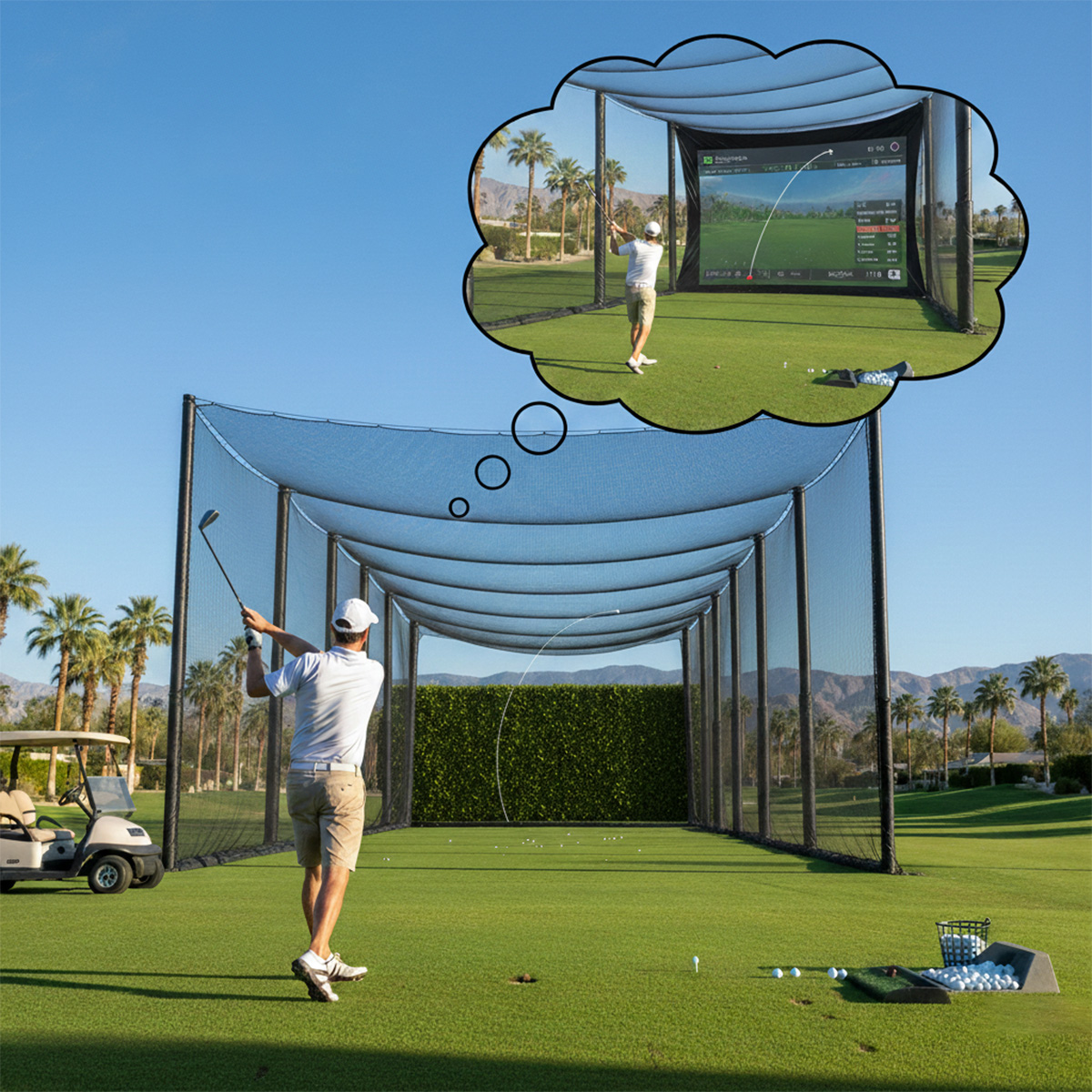
Launch Monitor Bays (TrackMan, FlightScope, etc.):
- 6-10 covered bays with high-quality mats (gel-based, not hard rubber)
- Top-tier launch monitors in each bay
- Screens showing virtual courses and driving ranges
- Premium hitting surfaces that provide realistic feedback
Outdoor Short-Distance Hitting Area:
- 75-100 yard landing area (much more achievable than 300 yards)
- Quality turf or mat stations
- Target greens at 50, 75, and 100 yards
- Launch monitors providing full data despite short distance
- Containment netting
Simulator Integration:
- Play virtual rounds on famous courses
- Compete in closest-to-pin contests
- Skills challenges and games
- Data tracking and storage
Membership/Usage Model:
- Complimentary for tee time holders (30-45 min pre-round)
- Monthly memberships for practice-only access
- League play and competitions
- Corporate events and team building
Why This Works:
Data Over Distance: Modern golfers increasingly value data (launch angle, spin rate, ball speed) over simply watching where balls land. Launch monitors provide professional-level feedback.
Weather Protection: Indoor/covered bays mean year-round practice regardless of conditions.
Revenue Generation: Beyond tee time support, this becomes a standalone revenue center through memberships, leagues, and events.
Space Efficiency: Generate traditional range value in 90% less space.
Solution 3: The Hybrid “Short Range” Model
The Concept: Build the shortest viable range that still provides useful feedback, supplemented by premium short game areas.
Real Estate Required: 3-5 acres
Investment: $250,000-600,000
What This Includes:
150-Yard Range:
- Sufficient for wedge through 7-iron practice (for most golfers)
- Natural grass tees (seasonal) and quality mat stations
- Target greens at 50, 75, 100, 125, and 150 yards
- Launch monitors at select stations
- Automated ball dispensing
- Quality range balls (not rock-hard)
“Full Swing” Launch Monitor Stations:
- 4-6 stations with monitors for driver/fairway wood practice
- Data shows full distance despite limited range length
- Covered/protected from elements
Premium Short Game Integration:
- Comprehensive chipping/pitching area (as described in Solution 1)
- Multiple putting surfaces
- Bunker complex
Transparent Communication:
- Signage: “150-Yard Range with Launch Monitor Technology for Full Clubs”
- Marketing: Position as “practice efficiency center”
- Emphasize data-driven practice
Why This Works:
Covers 80% of Needs: Most golfers warm up with short irons and wedges anyway. A 150-yard range handles this perfectly.
Technology Fills Gap: Launch monitors provide driver data without needing 300 yards.
Realistic Expectations: By being upfront about the 150-yard limitation while showcasing technology enhancements, you avoid disappointment.
Land Use Efficiency: 3-5 acres versus 10-15 for traditional range.
Solution 4: The Par 3 Practice Course
The Concept: Build a short 6-9 hole par 3 course that serves triple duty: practice, revenue generation, and beginner/junior development.
Real Estate Required: 5-10 acres
Investment: $400,000-1,200,000
What This Includes:
6-9 Hole Layout:
- Holes ranging from 60-140 yards
- Varied shot requirements (different clubs)
- Realistic green complexes
- Bunkers and hazards
- Playable by all skill levels in 60-90 minutes
Dual Functionality:
- Serves as practice facility (hit to actual greens)
- Generates revenue as playable course
- Tournament and event space
- League play venue
Integration with Main Course:
- Can serve as warm-up (play 3-4 holes before main round)
- Junior development program venue
- Instruction laboratory
- Corporate outing addition
Why This Works:
Revenue Positive: Unlike a range (operating cost), a par 3 course generates revenue through green fees, memberships, leagues, and events.
Real Golf: Golfers practice on actual greens with real consequences, not range targets.
Multiple Audiences: Serves beginners, juniors, seniors, practice-focused golfers, and quick-play customers.
Marketing Hook: “36 holes of golf” (18 championship + 9 par 3) sounds impressive.
Real Example:
Streamsong Resort in Florida built “The Gauntlet” – a 6-hole par 3 course on what would have been range land.
Financial impact:
- $50 per player green fee
- 12,000 rounds annually
- Gross revenue: $600,000/year
- Operating profit: $280,000/year
- Becomes differentiator in resort package sales
- Featured in media coverage extensively
The course serves as practice facility, revenue generator, and marketing asset simultaneously.
Mini Case Study:
Bandon Dunes’ “Punch Bowl” – A 100,000-square-foot putting course that’s free to play but keeps golfers on property longer, increases F&B sales, and creates social media moments. ROI through indirect revenue exceeds what a traditional range would provide.
Solution 5: The Off-Site Partnership Model
The Concept: Partner with a nearby facility to provide your golfers with range access.
Real Estate Required: 0 acres (your property)
Investment: $20,000-60,000/year in partnership fees
What This Includes:
Partnership Agreement:
- Negotiate bulk rate or annual fee with nearby range/practice facility
- Provide vouchers or membership access to your customers
- Transportation if facilities are close (shuttle service)
- Co-marketing opportunities
Customer Communication:
- “Practice facility located 1.5 miles away at XYZ Golf Center”
- Complimentary range balls with tee time (redeemed at partner facility)
- Shuttle service 90 minutes before tee times
On-Site Minimum:
- Quality putting greens (you still need these)
- Chipping area
- Maybe limited mat stations with launch monitors
Why This Works:
Cost Efficiency: No construction or ongoing maintenance costs.
Professional Facilities: Partner facility may have superior range to what you could build.
Focus Resources: Invest in course conditioning instead of range infrastructure.
Flexibility: Can terminate partnership if circumstances change.
When This Works Best:
- Urban/suburban courses with nearby public ranges
- Resort courses near golf complexes
- Courses where land is extraordinarily expensive
- Facilities focused on course experience over practice
Solution 6: The Grass Tee “Field” Range
The Concept: Ultra-minimalist grass range for courses in suitable climates with available land but limited budgets.
Real Estate Required: 4-6 acres
Investment: $60,000-150,000
What This Includes:
Natural Grass Hitting Area:
- 50-75 yard wide hitting corridor
- 200+ yards of depth
- Minimal irrigation (let it brown in summer if necessary)
- Rotate hitting areas to manage wear
- Natural target greens (mowed sections of field)
- Simple ball pickup system (baskets, manual collection)
No Frills Approach:
- No automated ball dispensers (baskets at starter area)
- No permanent structures
- Minimal landscaping
- Solar-powered lights or no lights
- Simple yardage markers
Seasonal Operation:
- May close in extreme heat or drought
- Rotational recovery periods
- Communicate limitations upfront
Why This Works:
Extremely Low Cost: A fraction of traditional range investment.
Real Grass Practice: Many golfers prefer grass tees even at simple ranges over mats at fancy facilities.
Honest Value Proposition: “Basic but functional” often beats “fancy but terrible” (looking at you, hard mats and net).
Rural/Resort Settings: Works well where land is available and aesthetics aren’t paramount.
Solution 7: The Indoor Performance Center
The Concept: Build a year-round indoor facility focused on teaching, fitting, and technology.
Real Estate Required: 0.1-0.25 acres (building footprint)
Investment: $300,000-800,000
What This Includes:
Climate-Controlled Building:
- 6-10 hitting bays with launch monitors
- Professional-grade simulators
- Fitting bay with full club selection
- Video analysis capability
- Lounge/waiting area
- Pro shop integration
Revenue Streams:
- Monthly memberships
- Daily/hourly bay rentals
- Club fitting fees
- Instruction packages
- Simulator play (virtual rounds)
- Corporate events
- League play
Course Integration:
- Complimentary pre-round warmup for tee time holders
- Discounted memberships for season pass holders
- Data integration (track performance over time)
Why This Works:
Year-Round Operation: Weather never closes you down.
Multiple Revenue Streams: Becomes profit center, not cost center.
Premium Positioning: Indoor technology centers feel modern and sophisticated.
Space Maximization: Delivers range value in minimal footprint.
The Realistic Tiered Approach
Based on budget and space constraints, here’s how to prioritize:
Tier 1: Minimal Investment ($25,000-75,000)
- Replace hard mats with gel-infused quality mats
- Add 2-3 launch monitor stations
- Improve putting greens
- Create dedicated chipping area
- Install quality ball dispensing
Impact: Transforms terrible practice to acceptable.
Tier 2: Moderate Investment ($150,000-300,000)
- Build comprehensive short game facility
- Add 4-6 covered launch monitor bays
- Create small (75-100 yard) hitting area
- Premium putting surfaces
- Lighting for extended hours
Impact: Creates competitive practice facility despite no traditional range.
Tier 3: Significant Investment ($400,000-800,000)
- Full short game academy
- 10+ launch monitor bays with simulators
- 150-yard range or par 3 course
- Year-round capabilities
- Revenue-generating model
Impact: Turns limitation into competitive advantage and revenue center.
The Communication Strategy
However you solve your range limitation, how you communicate it matters enormously.
Bad Approach:
Silent on website about practice facilities. Golfer shows up expecting full range, finds hard mats and net, feels deceived.
Good Approach:
“Practice Facilities: Our Short Game Academy features multiple putting greens, comprehensive chipping areas, and technology-enhanced hitting bays. While we don’t have a traditional driving range, our launch monitor stations provide professional-grade feedback for all clubs.”
Great Approach:
“Why We Don’t Have a Traditional Range: We chose to invest in what golfers actually need—the best short game practice facility in Arizona and state-of-the-art launch monitor technology that provides more useful feedback than watching balls land 200 yards away. The result? Golfers are better prepared for their rounds in less time.”
Own your decision. Make it a feature, not a bug.
What That Desert Course Should Do
Remember that pristine desert course I started with? Here’s my recommendation:
Immediate (0-3 months, $40,000):
- Replace hard mats with quality gel-based mats
- Install 3 TrackMan stations at existing mat area
- Add shaded seating and water station
- Improve signage explaining technology benefits
- Staff the area during busy times to help with monitors
Short-term (6-12 months, $200,000):
- Build comprehensive short game academy (they have space)
- Add covered/shaded launch monitor bays
- Create 75-yard short iron hitting area with target greens
- Market as “Short Game Performance Center”
- Develop instruction programming
Expected Impact:
- Guest satisfaction with practice facilities: 2.1/5 → 4.3/5
- Golfers arriving early: +35%
- Pro shop pre-round sales: +$85,000/year
- Instruction revenue: +$120,000/year
- Online review mentions (positive): +200%
The Fundamental Truth
Here’s what I’ve learned from playing courses worldwide with every practice facility configuration imaginable:
Golfers don’t necessarily need a 300-yard driving range. But they absolutely need adequate practice facilities that match the quality of the golf course.
A $225 course with hard mats and a net is a mismatch. A $225 course with an exceptional short game academy and launch monitor bays is a premium experience.
The question isn’t “Can we afford to build a range?”
The question is “What’s the right practice solution for our real estate, budget, and guest expectations?”
Because every course I’ve seen that thoughtfully solved their range limitation ended up with something better than a mediocre traditional range—and their guests agree.
Action Plan for Course Operators
This Month:
- Honestly assess your current practice facilities
- Survey recent guests about practice experience
- Mystery shop competitors’ practice areas
- Calculate lost revenue from poor practice facilities
This Quarter:
- Determine budget for practice facility improvement
- Assess available real estate options
- Get proposals for 2-3 different solution approaches
- Build financial model showing ROI
This Year:
- Implement chosen solution
- Market the hell out of it
- Track impact on guest satisfaction
- Measure revenue impact (direct and indirect)
The Bottom Line:
Not having space for a traditional range isn’t a death sentence—it’s an opportunity to differentiate. The courses winning are those creative enough to turn their limitation into an advantage.
Because somewhere right now, a golfer is standing on hard mats hitting balls into a net 30 yards away at a $200+ course, pulling out their phone, and telling their friends: “Amazing course, but skip the ‘range.'”
That golfer could instead be posting: “Best short game facility I’ve ever seen—worth showing up early.”
Your move.
About Golf Consultants
We specialize in helping golf courses maximize their facilities within real-world constraints. From practice facility design to full operational optimization, we turn limitations into competitive advantages.
Practice Facility Consulting:
- Space utilization analysis
- Technology integration planning
- Short game facility design
- ROI modeling and financial planning
- Vendor selection and negotiation
Contact: Golf Consultants | San Diego, CA | golf-consultants.com
AI Generated Vignette for Privacy Reasons